Urban renewal that focuses on adaptability, affordability, innovation and liveability
By Joseph Wong
The health of Malaysia’s property sector is determined by more than just towering glass facades and sprawling suburban developments. Behind every high-rise and residential estate lies a delicate, continuous negotiation between local authorities, private developers and the public. How well these distinct stakeholders collaborate dictates not only the nation’s macroeconomic growth but also whether everyday Malaysians have access to safe, sustainable and well-planned homes.
As the industry navigates a complex economic environment, market forces are shifting. The primary market is experiencing structural cooling while a highly resilient secondary market, innovative building adaptation strategies and a public-centric approach to urban governance are redefining the landscape. Together, these elements are moving the Malaysian real estate industry away from reactive crisis management toward proactive, data-driven planning.
At the heart of the national housing strategy is the push for sustainable homeownership, a primary driver of macroeconomic growth. Data from the Ministry of Housing and Local Government (KPKT) shows that 76.5% of Malaysians own their homes. To lower barriers for younger families and first-time buyers, federal initiatives are providing substantial financial cushions. Financial frameworks have allocated RM40bil for government-guaranteed housing schemes, including the Syarikat Jaminan Kredit Perumahan (SJKP), alongside targeted stamp duty exemptions and interest rebates for properties priced below RM500,000.
However, financial accessibility is only half the battle; the delivery mechanism itself requires structural trust. The historical prevalence of the Sell-Then-Build (STB) model has exposed buyers to significant systemic risks, often resulting in stalled projects when developers encounter cash flow bottlenecks.
To rectify past failures, the Task Force on Sick and Abandoned Private Housing Projects (TFST) has revived about 1,500 sick and abandoned projects across the nation, reclaiming approximately 173,000 residential units representing a Gross Development Value (GDV) of RM140bil. Backed by dedicated fiscal allocations for rehabilitation, local authorities are stepping in as vital mediators to restore market confidence.
To permanently address this vulnerability, regulatory bodies are advocating for a transition to the Build-Then-Sell (BTS) framework. By ensuring that homes are fully completed before capital changes hands, the BTS model eliminates buyer exposure to construction failure. To incentivise this shift, the government offers participating developers regulatory fast-tracking and exemptions from standard Housing Development Account (HDA) deposit rules, laying the groundwork for a more stable and secure marketplace.
Lifespan of a building
As the industry re-evaluates project delivery, it is also rethinking the lifecycle of completed structures. While urban renewal conversations frequently focus on the wholesale demolition and redevelopment of dilapidated strata schemes, this approach overlooks the profound environmental and economic value of building adaptation.
Rather than executing costly, carbon-intensive demolition cycles, building adaptation modifies existing structures to extend their lifespans, optimise performance and adjust their functions to modern demands. This practice reduces the consumption of embodied carbon, which is the emissions generated during material manufacturing and initial construction, making it a cornerstone of sustainable urban development.
Depending on structural layout and municipal zoning constraints, building adaptation generally follows five distinct operational pathways.
A prime corporate example of refurbishment is Menara Standard Chartered on Jalan Sultan Ismail. By modernising its tenant spaces, lift systems, and security technologies, the building has retained its Grade-A status within Kuala Lumpur’s Golden Triangle.
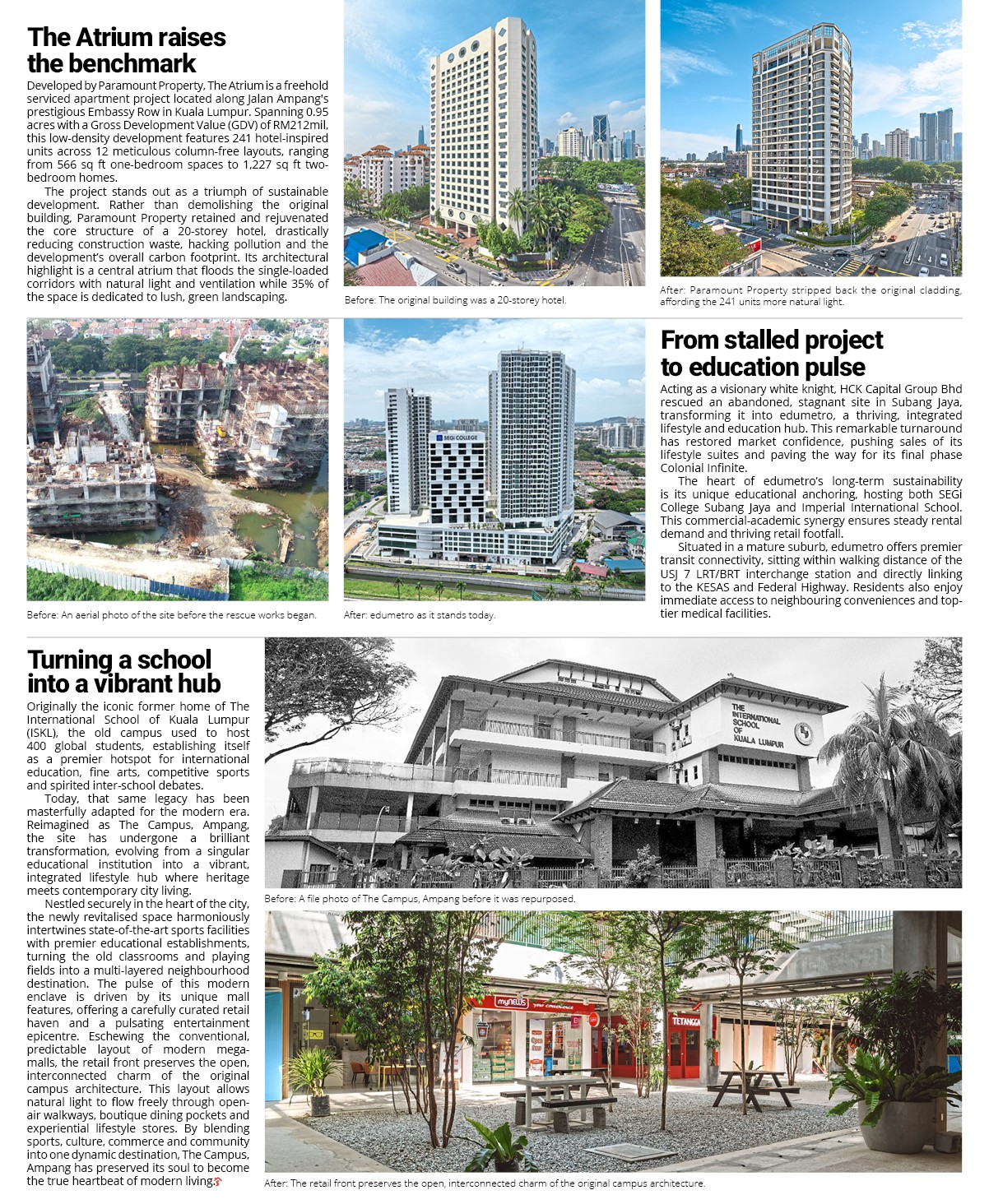
Other successful instances of adaptive reuse were also seen during this year’s StarProperty Awards, with The Campus, Ampang (Community Hub), edumetro @ Subang Jaya (Mixed Development) and The Atrium (Residential) winning their respective sub-categories.
All three projects were lauded for their creativity in reimagining old structures during the judging session held earlier in the year. These projects signify a shift in the industry toward preserving urban character while meeting the evolving needs of modern communities.
To determine if an ageing asset is viable for these interventions, engineers evaluate properties against five strict engineering performance criteria, namely convertability, dismantlability, disaggregability, expandability and flexibility.
When considering covertability, the structural and legal ease of switching the building’s primary use economically is paramount. Dismantlability refers to the capacity of the internal components to be safely and rapidly deconstructed while disaggregability considers the ability to separate, sort and reprocess core materials for reuse. Expandability regards the feasibility of adding physical volume or extending floor areas safely, and flexibility covers the ease of reconfiguring interior floor layouts without disturbing structural load paths.
Humanising urban renewal
When aggressive urban development collides with established neighbourhoods, it often creates social friction. In dense metropolitan areas like Kuala Lumpur, public parks serve as essential social infrastructure, offering accessible communal spaces for recreation, multi-generational interaction and physical well-being.
This issue came to the forefront following warnings from Federal Territories Minister Hannah Yeoh, who emphasised that safeguarding urban green spaces must remain a top administrative priority to maintain city liveability. When public assets are commercialised or replaced by smaller, privately managed open spaces, the surrounding community loses a vital element of its social safety net, disproportionately impacting lower-income families and senior citizens.
This tension is central to the ongoing debates surrounding the currently shelved Urban Renewal Act (URA). While proponents argue the legislation is required to revitalise failing infrastructure, civic groups warn that provisions aiming to lower owner-consent thresholds risk prioritising speed and corporate profitability over community alignment. For long-term residents, this raises concerns about forced displacement, gentrification and the loss of local support networks.
To resolve this conflict, progressive urban planners are advocating for the integration of a Happiness Index into the statutory approval process. Shifting the analytical lens away from narrow economic metrics like Gross Domestic Product (GDP) or land plot optimisation, a Happiness Index evaluates urban success based on mental health, safety, social cohesion and equitable access to public space.
By prioritising neighbourhood stability, this framework changes how municipal authorities review development proposals. Instead of opting for wholesale demolition, the index encourages contextual regeneration and localised revitalisation. It directly recognises that forced displacement incurs long-term public costs such as increased civic isolation and declining community health, which ultimately impact public budgets.
While there are still uncertainties regarding urban renewal, the shift from developing greenfield projects to regenerating brownfield developments is slowly gaining momentum, especially in older parts of cities in Malaysia and around the world. This shift is inevitable as evidenced in cities like London in the United Kingdom and Melbourne in Australia. And as Malaysian cities continue to age, urban renewal projects will become more prominent.








POST YOUR COMMENTS